
Monday, February 10, 2014
Some members of the New York City Police Department are having their official uniforms outfitted with a high-tech addition apparently as reports surface that the NYPD has acquired several pairs of Google Glass.
According to the website Venture Beat, a ranking member of the largest local law enforcement unit in the United States told reporters there that the NYPD is toying with the possibility of using the state-of-the-art gadgets for official police business.
“We signed up, got a few pairs of the Google glasses and we’re trying them out, seeing if they have any value in investigations, mostly for patrol purposes,” the unnamed NYPD officer said.
“We’re looking at them, you know, seeing how they work,” he added.
Venture Beat’s original article ended just about there, but the New York Post reported quickly after on Thursday this week that they have a source who says much of the same.
“A handful of people are testing it out,” that source said the Post, adding that the agency has only recently begun preliminary testing with the devices.
“If it works, it could be very beneficial for a cop on patrol who walks into a building with these glasses on,” the source said. “It would be like the Terminator. You walk past somebody and you get his pedigree info if he’s wanted for a warrant right on your eye screen...”
(more)


Sunday, December 29, 2013
(csmonitor)
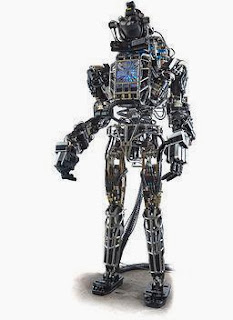
At a NASCAR racetrack in Miami earlier this month, teams from NASA, Google, and 14 other groups of engineering gurus put cutting-edge robots through some challenging paces.
The aim was to see how well the robots could tackle tasks that may sound simple, but are tricky for nonhumans – including, say, climbing a ladder, unscrewing a hose from a spigot, navigating over rubble, and steering a car.
The contest was dreamed up by the Pentagon’s futuristic experimentation arm, the Defense Advanced Research Projects Agency (DARPA), and senior defense officials were watching it carefully – well aware that the Pentagon is growing increasingly reliant on robotics.
The Defense Department will become even more reliant on such devices in the decades to come. That’s the conclusion of a new blueprint quietly released by the Pentagon this week, which offers some telling clues about the future of unmanned systems – in other words, drones and robots.
The study, the Unmanned Systems Integrated Roadmap, is meant to provide the Pentagon with a “technological vision” for the next 25 years – a vision that will be “critical to future success” of the US military, according to its authors.
“Over the past decade, the qualities and types of unmanned systems acquired by the military departments have grown, and their capabilities have become integral to warfighter operations,” the study notes. “The size, sophistication, and cost of the unmanned systems portfolio have grown to rival traditional manned systems....”
(more)
Sunday, November 17, 2013
(usatoday)
The U.S. intelligence community is pushing a leap forward in facial recognition software that will enable it to determine better the identity of people through a variety of photographs, video and other images.
Called Janus, the program run by the Intelligence Advanced Research Projects Agency (IARPA), "seeks to improve face recognition performance using representations developed from real-world video and images instead of from calibrated and constrained collections. During daily activities, people laugh, smile, frown, yawn and morph their faces into a broad variety of expressions. For each face, these expressions are formed from unique skeletal and musculature features that are similar through one's lifetime. Janus representations will exploit the full morphological dynamics of the face to enable better matching and faster retrieval."
Documents released by IARPA over the weekend show that the Janus program will start in April 2014 and run for four years. During that time, the agency hopes to "radically expand the range of conditions under which automated face recognition can establish identity."
A division of the Office of the Director of National Intelligence, IARPA was created in 2006 and modeled after DARPA, the Pentagon's agency that researches technology for future military uses. Another branch of the intelligence community, a venture capital firm run by the Central Intelligence Agency called In-Q-Tel, invests in companies that develop facial recognition software.
Civil liberties groups, such as the American Civil Liberties Union and the Electronic Privacy Information Center, have raised concerns about unchecked uses of facial recognition software....
(more)
Friday, October 25, 2013
(usatoday)
Be careful what you say on the phone in a crowd of people.
Former National Security Agency director Michael Hayden learned that lesson on a train Thursday.
Hayden gave background interviews to reporters -- meaning he was not to be quoted by name -- but a fellow passenger on an Amtrak Acela train tweeted out his comments to the entire cyber-world.
"Former NSA spy boss Michael Hayden on Acela behind me blabbing 'on background as a former senior admin official,' sounds defensive," tweeted Tom Matzzie, founder of the Ethical Electric Company.
Matzzie, upset at criticisms of President Obama by the former George W. Bush administration official, also tweeted: "Michael Hayden on Acela giving reporters disparaging quotes about admin. 'Remember, just refer as former senior admin.'"
Another entry: "Hayden was bragging about rendition and black sites a minute ago."
Friends of Hayden no doubt alerted him to the broadcast of his background interviews, and he went over to talk to Matzzie.
Matzzie tweeted that out, too.
"I just had a very nice conversation with Michael Hayden," Matzzie wrote. "He was a gentleman and we disagree."
(more)

Thursday, October 03, 2013
(huffingtonpost)
A small camera-equipped drone reportedly crashed into a New York City sidewalk on Monday evening, narrowly missing a businessman who was heading home from work.
The unmanned aircraft, identified by ABC 7 New York as a "Phantom Quadcopter," was apparently zipping around taking scenic footage of Manhattan's skyscrapers before it plummeted into the pavement.
An anonymous financial analyst who was nearly hit by the radio-controlled craft removed its video card and provided it to ABC 7 on Wednesday.
(more)

Monday, September 23, 2013
(reason)
Last month came word that Ohio's sneaky Attorney General Mike DeWine had quietly integrated facial recognition software into the Ohio Law Enforcement Gateway, a state database that includes driver's license photos. Caught, the AG promised to create a commission to develop protocols for using the technology, tacitly admitting that no safeguards were in place on a system that turned every Ohio driver into a participant in a police line-up—if the system were used as intended—and a potential stalking target by any whack job with a badge. Now comes news that the ranks of potential whack jobs with access to the database are large, indeed—larger than in any other state, at least.
Ohio’s new facial recognition system has fewer restrictions for its use than similar systems in any other state in the U.S., an Enquirer/Gannett Ohio investigation has found.
No other such system in the nation allows 30,000 police officers and court employees to search driver’s license images, without audits or oversight.
By contrast, Kentucky allows 34 people the ability to run facial recognition searches. Twelve states don't have the technology, with Maine law forbidding its use by state agancies. Several states that do possess facial recognition technology for checking driver's licenses don't allow law enforcement to use it at all.
But Ohio has no such restrictions. "Ohio’s 30,000 users include local and state police, sheriffs, civilian employees of police departments, court employees – even out-of-state and federal law enforcement agencies,."
Beyond the obvious flaws in a system that compares everybody's driver's license photo to crime-scene snapshots of iffy quality and looks for matches via technology of unknown reliability, is the very real danger of unofficial use. Government databases have a history of such abuse. Minnesota cops cyberstalked a attorney, among others, inappropriately pulling up her driver's license data 700 times. Florida police were caught hate-stalking a colleague who arrested a fellow officer. They also trawled the database for potential dates and other petty (but creepy) purposes...
(more)

(wsbtv)
Well, that didn’t last long. Less than 48 hours after Apple began selling its new iPhone 5s with the Touch ID fingerprint security system, someone’s managed to find a way around it.
A member of the German hacker organization Chaos Computer Club posted a video to YouTube Sunday showing one of the new iPhones being hacked with a lifted fingerprint.
Despite Apple’s claims about the advanced security of the Touch ID, the CCC says Apple’s sensor is just a high-res version of existing technology and can be cracked with a sharp photo of the fingerprint and a laser printer.
A spokesman for the organization says the speedy hack illustrates the inherent risks of using fingerprints as a security measure and urges Apple customers to return to numeric passcodes to protect their phones.
“We hope that this finally puts to rest the illusions people have about fingerprint biometrics. It is plain stupid to use something that you can’t change and that you leave everywhere every day as a security token...”
(more)

Thursday, September 19, 2013
(rt)
Hockey fans in Washington state will have more to worry about this weekend than avoiding a puck to the face: the Department of Homeland Security will be testing out a new facial recognition system at an arena this Saturday.
The 6,000 seat Toyota Center in Kennewick, Washington will be the site on Saturday for more than just the Tri-City American’s season opener. In addition to hosting a junior ice hockey game, the arena will also facilitate the testing of a DHS program that’s raising concerns among privacy advocates.
Homeland Security will have a presence at Saturday’s game, but won’t be conducting any pat-downs on patrons or even rooting for the home team. Instead, DHS will utilize a sophisticated system of cameras to collect pictures of attendees in real-time from as far away as 100 meters and then match them up with images of faces stored on a database.
The exercise will mark the latest drill for the DHS’ Biometric Optical Surveillance System, or BOSS, and when it’s fully operational it could be used to identify a person of interest among a massive crowd in the span of only seconds.
With assistance from researchers at the Pacific Northwest National Laboratory, DHS will attempt to quickly compare faces caught on camera with the biometric information of 20 volunteers. The other faces in the crowd — potentially 5,980 hockey fans — will exist as background noise to see how accurate BOSS is when it comes down to locating a person of interest...
(more)
Don't go to this fucking game. Send a message to these fuckers.


All Rights Reserved By Author -- Copyrighted Material Used Under Fair Use

